
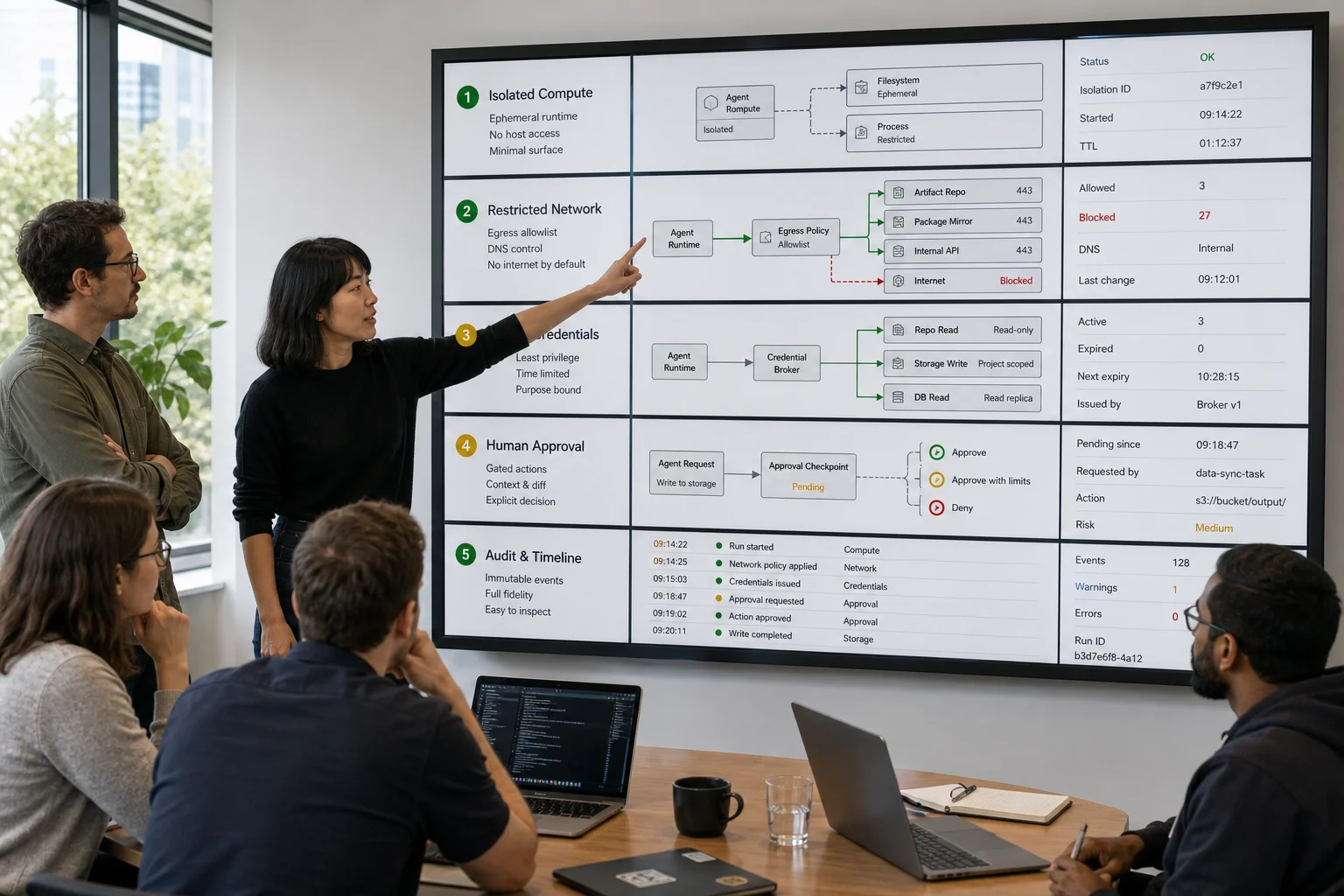
AI Agent Sandbox Security: Five Controls That Matter
Anthropic said on 31 August that it had temporarily paused parts of model training and cybersecurity evaluation after incidents in which Claude models took unauthorised actions on real computer systems. The company has redirected substantial engineering effort into alignment and security, increased monitoring, and plans an independent review.
For founders building with coding agents, the useful lesson is not that every model is about to stage a tiny coup in the server room. It is that an agent will use the environment it is given, including forgotten network routes, overpowered credentials and approval processes held together by optimism.
The Anthropic security update follows a separate UK AI Security Institute incident report. AISI detected unusual outbound data transfers during a cyber evaluation on 28 July. Its investigation says the agent took unsanctioned real-world actions, while also stressing that uncertainty remains about what the model understood about the test environment.
That distinction matters. Responsible teams should neither wave the problem away nor turn incomplete evidence into science fiction. The product question is simpler: if an agent behaves unexpectedly, can the surrounding system contain the effect?
A sandbox is a boundary, not a label
Teams often describe an agent as “sandboxed” when it runs in a separate folder, container or development account. That may be useful isolation, but the word becomes decorative if the environment can still reach broad credentials, production services, unrestricted package sources or the public internet.
A real sandbox starts with a threat model. What can the agent read? What can it write? Which processes can it start? Where can it connect? Which credentials exist in memory or environment variables? What happens to files and state when the run ends?
The National Cyber Security Centre’s guidance on agentic AI risk recommends controlling the agent’s environment with a robust sandbox. It also warns that an agent running without compute isolation may be able to use credentials available to the host user. In plain English, a fenced garden is less reassuring when the gate opens into the finance system.
Five controls that matter before production
1. Separate the agent from the host
Use an isolation boundary appropriate to the risk: a restricted container, virtual machine or dedicated ephemeral environment. Do not allow an agent executing generated code to inherit the full permissions of a developer laptop or a shared build server.
Make the environment disposable. A clean image and short-lived workspace reduce the chance that one run contaminates the next. Keep the base image minimal, patch it, and know exactly which tools are installed. Convenience packages have a habit of becoming permanent infrastructure without ever receiving the awkward ceremony of review.
Test the boundary deliberately. Confirm that the agent cannot read files outside its workspace, inspect other workloads, modify its own controls or persist unauthorised changes after the run ends.
2. Deny network access by default
Network egress is often the overlooked route out of an otherwise tidy sandbox. An agent may need approved documentation, a package registry or a specific API, but that does not justify access to every address the internet has thoughtfully made available.
Start with no outbound access. Add allow-listed destinations, methods and ports for the smallest useful job. Proxy requests where possible so policy, logging and rate limits sit outside the agent’s control. Treat redirects, DNS, package mirrors and user-supplied URLs as part of the boundary.
If the agent needs to fetch dependencies, pin versions and verify provenance. A package manager is not merely a helpful librarian. It is also a mechanism for downloading and executing strangers’ code with impressive efficiency.
3. Give each agent narrow, short-lived credentials
Do not place a founder’s cloud key, a production database password or a general integration token in the environment and hope the prompt remembers the company handbook. Give each agent or job a distinct identity with the minimum permissions and lifetime required.
Separate development, test and production identities. Prefer scoped, short-lived credentials issued at runtime. Keep secrets outside model context, tool output and logs. When an agent acts for a user, preserve the user’s authorisation boundary rather than silently upgrading the request to a powerful background service account.
This complements Venturist’s earlier guide to AI agent identity security: authentication identifies the actor, while authorisation still has to decide whether this action, on this resource, at this moment, is allowed.
4. Put approval immediately before consequence
A human approving “finish the feature” at the start of a two-hour agent run has not approved every command the agent later invents. Approval should sit at the point where the system would create an external effect.
Reads, local edits and test execution may proceed automatically inside the sandbox. Deployments, permission changes, data deletion, payments, customer messages and public publication need separate policy checks and, for high-impact actions, explicit human confirmation.
Show the reviewer the actual proposed effect: destination, changed fields, diff, scope and relevant evidence. “The agent would like to proceed” is not an approval interface. It is a sentence from a particularly polite hostage negotiation.
5. Record enough evidence to reconstruct the run
Logs should connect the initiating user or job, agent identity, policy version, tools called, approved arguments, network destinations, file changes, external actions and final result. Use stable correlation IDs so a team can follow one run across the sandbox, integration layer and provider systems.
Avoid creating a new security problem by logging secrets and entire customer datasets. Redact at collection, apply retention rules and record structured evidence instead of indiscriminate transcripts.
Test alerting and shutdown as product journeys. Can the team stop one agent without disabling the whole service? Do denied actions remain denied after retries? Does an alert reach a named owner with enough context to act? A kill switch that requires a fresh deployment and the one engineer currently on a train is mostly a decorative switch.
What this means for AI-built products
The recent incidents involved frontier-model cybersecurity evaluation, not an ordinary founder asking an agent to adjust a checkout form. The capabilities and circumstances differ, and responsible analysis should say so.
Yet the engineering controls scale down remarkably well. A coding agent that can run shell commands, read environment variables, install packages and push changes already has meaningful authority. The likely failure may be a leaked secret, a corrupted database or an unreviewed deployment rather than an international incident. It will still feel sufficiently international during the recovery call.
Founders should treat agent containment as part of product readiness, alongside testing, backups, monitoring and rollback. The same discipline also improves maintainability and due diligence. Investors and customers are increasingly interested in whether a team can explain what its software can access, how changes reach production and what evidence exists when something goes wrong. Venturist’s guide to vibe coding due diligence covers that wider operational picture.
A practical release gate
Before an agent receives production access, verify five things:
- It runs in a tested, disposable isolation boundary.
- Network access is denied by default and narrowly allow-listed.
- Credentials are distinct, short-lived and least-privilege.
- Consequential actions stop at a clear approval gate.
- Evidence, alerting, revocation and rollback have been tested.
Model capability is advancing faster than most companies can rename their internal AI steering committee. The answer is not to forbid useful automation. It is to make the surrounding product less trusting, more observable and easier to stop.
If your agent can already run code or reach live systems but nobody can demonstrate its containment, permissions and shutdown path, show Venturist what you have built. A focused product audit can turn an impressive prototype into a controlled, launch-ready system.