
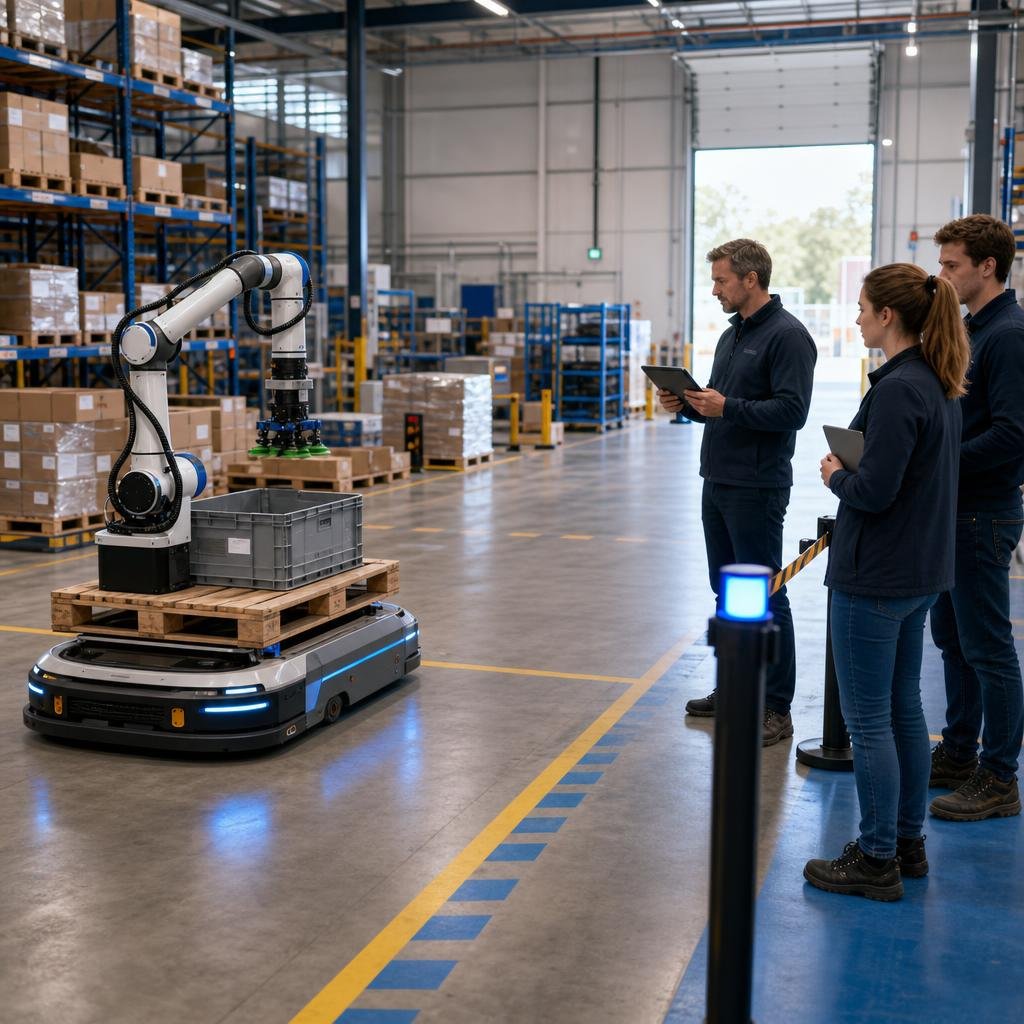
Physical AI production readiness: beyond the demo
Physical AI has reached the stage where a robot can perform a complicated task on a conference floor while somebody nearby explains that the future has arrived. The future then meets a loose cable, a warehouse Wi-Fi dead zone and a pallet placed six centimetres to the left.
That gap between an impressive demonstration and a dependable product is the useful theme emerging from Actuate 26, the robotics developer conference held in San Francisco on 18 and 19 August. Its programme focuses less on whether machines can move, grasp and reason, and more on the infrastructure, data, safety and operating practices required to deploy them alongside people.
For founders building physical AI products, that is the right conversation. A successful demo proves that the system can work. Production readiness asks whether it can keep working, explain why it failed, recover safely and make economic sense when there are 100 machines instead of one cherished prototype with three engineers standing behind it.
A robot is a product, a fleet and an operations system
Software founders already know that a polished interface can conceal a fragile backend. Robotics adds motors, sensors, battery state, changing environments and the occasional object that has declined to be where the model expected it.
The robot itself is only one part of the product. A commercial deployment also includes fleet management, identity and access control, site connectivity, remote updates, customer workflows, incident handling, data retention, support tools and a way for a human to intervene without improvising over a video call.
IT Pro's 2026 review of autonomous robotics makes the commercial point clearly: progress is increasingly about deployment, interoperability and integration with the systems that already run a warehouse or factory. A machine that navigates brilliantly but cannot receive work from the warehouse system, report an exception or coordinate with people has produced a technically sophisticated queue.
Production readiness therefore belongs to the whole operating system around the robot. The model matters. So do the less photogenic parts that prevent Tuesday afternoon from becoming an unscheduled field trial.
Reliability changes shape at fleet scale
A prototype that fails once a week may look encouraging. Multiply that behaviour across 100 deployed units and the business sees roughly one failure every 100 minutes. The same defect has moved from an engineering footnote to a permanent operations rota.
Foxglove uses a similar example in its guide to robotics observability. The important lesson is not the particular arithmetic. It is that fleet reliability is a distribution, not a heroic story about the best run the team recorded.
Product teams need evidence across representative sites, hardware revisions, environmental conditions and software versions. Track successful task completion, interventions, safety stops, degraded modes, recovery time, battery and connectivity failures, and the operational cost of keeping the system useful.
A 99 per cent task success rate may sound excellent until the remaining one per cent blocks a production line, damages stock or requires a specialist to travel to site. The denominator is where optimistic product plans often go for a quiet lie-down.
Observability has to survive the physical world
When cloud software fails, teams expect logs, metrics, traces and a reproducible request. A physical AI incident may involve camera feeds, lidar, actuator state, model outputs, control decisions, maps, network conditions and human actions, all moving on different clocks.
Production systems need a coherent record of what the machine sensed, decided and did. That record must identify the software and model versions, configuration, site, device and operator context involved. Without it, the team can see that the robot stopped but not whether the cause was perception, planning, hardware, connectivity or an upstream instruction that was wrong with unusual confidence.
Recording everything continuously is rarely practical. Sensor data can be enormous, upload capacity varies by site and sensitive footage needs careful retention. Design a tiered data strategy:
- stream health signals and safety events needed for live operations;
- buffer high-fidelity data locally around important incidents;
- upload selected recordings for diagnosis, evaluation and replay;
- use consistent timestamps, schemas and version identifiers;
- redact or restrict sensitive data before it becomes a convenient second surveillance system.
The Actuate agenda includes robot data infrastructure, fleet operations, simulation, evaluation and the loop from field data back into development. That is not background plumbing. It is how a team turns a strange field event into a reproducible test instead of a folklore entry in the support channel.
Design failure before adding autonomy
Autonomy is often presented as a dial that moves neatly from manual to magical. Real products need explicit operating modes.
Define what the robot does when confidence falls, a sensor becomes unavailable, connectivity disappears, a task cannot be completed or a person enters a restricted area. It may pause, return to a safe location, request assistance, switch to a limited mode or hand control to an authorised operator. The correct response depends on the product, but it should not be invented by whichever component notices the problem first.
Human intervention also needs product design. Operators require enough context to understand the alert, an unambiguous set of permitted actions and confirmation that the machine reached a safe state. Remote control needs authentication, authorisation, session recording and limits that reflect the physical consequence of a command.
A stop button matters. So does testing whether it works when the network is poor, the backend is unavailable and the latest software update has discovered a fresh interpretation of success.
Integrations are part of the safety case
A robot may be physically capable and still create operational risk through an incorrect job, stale inventory record or duplicated command. Every external connection needs a contract covering identity, permissions, timeouts, retries, idempotency and reconciliation.
Separate a request from a committed action. If an AI planner proposes moving an item, the execution layer should still validate location, permissions, current state and safety conditions. A model's confidence is not an authorisation mechanism, however attractively it arrives formatted.
Test partial failure across the complete workflow. What happens when the warehouse system assigns a task but the robot never acknowledges it? When the robot completes the movement but the inventory update times out? When two systems retry the same instruction? These are ordinary distributed-systems questions with the added benefit of something heavy now being in motion.
Ship software as though the machine is somewhere else
Robotics teams often debug prototypes directly, changing configuration on the device until the demonstration behaves. Production fleets need controlled releases.
Use signed, versioned artefacts and configuration. Separate development, test and production identities. Roll changes out to a small cohort, compare behaviour against a baseline and retain a tested rollback path. Record which hardware, model and configuration combinations are supported rather than allowing each unit to become a small museum of past decisions.
Simulation and replay should be release gates, not theatre. Build a corpus from common journeys, known failures, difficult environmental conditions and safety-relevant edge cases. A release should show where it improved, where it regressed and which risks remain untested.
Then validate on representative hardware in representative sites. Simulation is exceptionally useful, but it has never been inconvenienced by a scratched lens, a reflective wrapper or a facilities manager moving a charging station during lunch.
Measure the business system, not the spectacle
Physical AI earns its place by improving an operation. Product metrics should therefore connect machine behaviour to throughput, quality, downtime, intervention cost, safety, customer satisfaction and the time required to deploy another site.
Track the amount of bespoke engineering needed for every customer. If each installation needs unique code, unique dashboards and a particular employee who remembers the calibration ritual, the company may have a consultancy project wearing a hardware multiple.
Investment readiness depends on this distinction. A buyer or investor will want to know whether deployments are repeatable, margins improve with scale, field failures create usable learning and support demand remains proportionate. A video of the robot succeeding is evidence of capability. It is not yet evidence of a business.
A production-readiness checklist for physical AI
- Product boundary: define the task, environment, prohibited actions and human responsibilities.
- Fleet identity: give every device, service and operator a distinct identity with minimum permissions.
- Data and observability: capture the signals needed to reconstruct decisions, failures and interventions.
- Safe degradation: specify behaviour for low confidence, lost connectivity, sensor failure and blocked tasks.
- Integration discipline: validate commands, make consequential actions idempotent and reconcile partial failures.
- Release control: evaluate, canary, monitor and roll back software, models and configuration.
- Operational design: give support teams useful tools, clear escalation and secure intervention paths.
- Commercial evidence: measure deployment effort, intervention cost, reliability and customer-level outcomes.
What launch-ready looks like
A launch-ready physical AI product does not need perfect autonomy. It needs a clear job, controlled behaviour, evidence from representative conditions and an operating model that handles exceptions without summoning the founding team to every site.
The useful shift at Actuate 26 is from asking whether physical AI is possible to asking what makes it dependable. The answer is not one larger model. It is disciplined product engineering around the model: observability, integration, safety, release control, support and economics.
If your physical AI prototype works in the demo but its fleet data, failure modes, integrations or rollout plan still live in separate notebooks, show Venturist what you have built. A focused product audit can turn the machine's best run into a credible route to repeatable deployment.